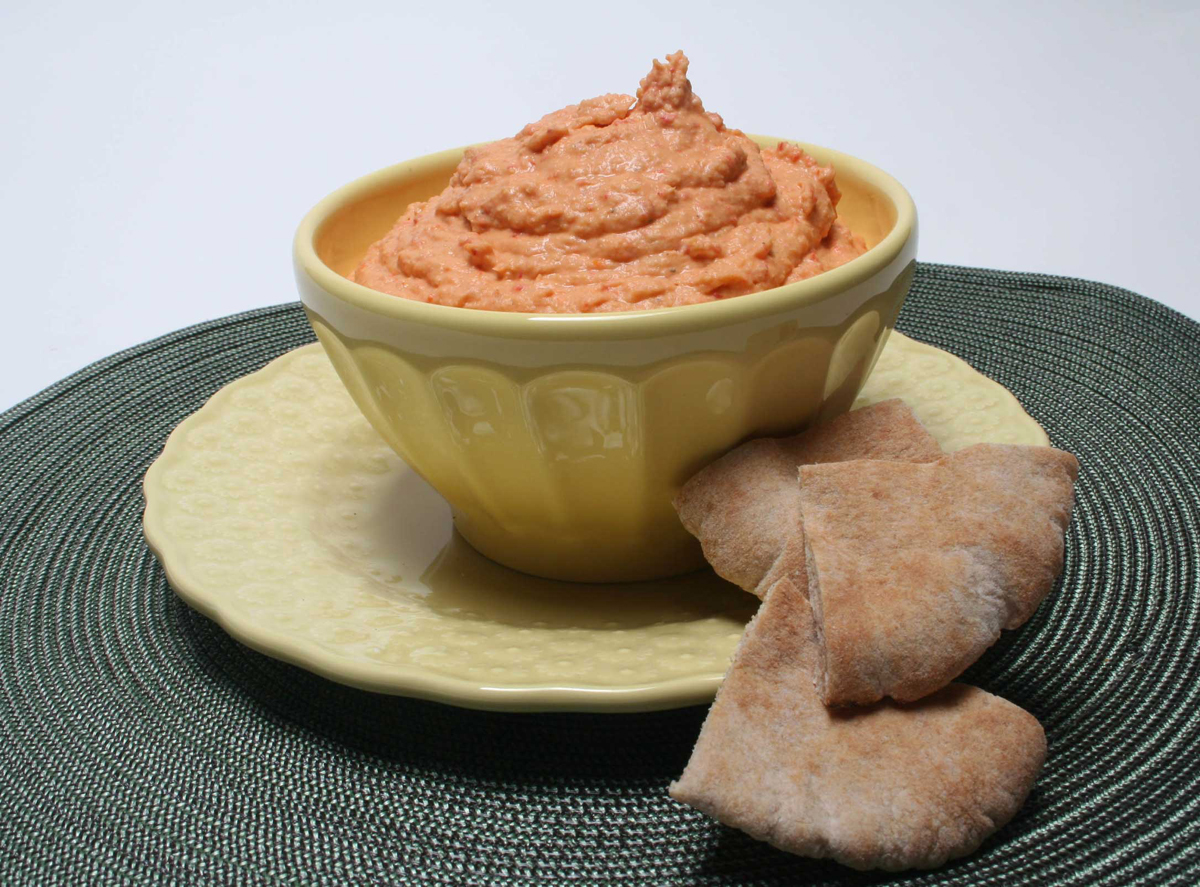
Roasted Red Pepper Hummus
Unexpected Guests? Serve This
Summer is the time of year when I most frequently find myself preparing food on short notice for unexpected company or al fresco meals. It may be something for guests who drop in unannounced or when a bunch of neighborhood kids suddenly decide to hang out at my place; or it might be a picnic hastily assembled so we can join friends at an outdoor concert or head to the beach for a sunset supper.
Fortunately, a repertoire of dishes I have learned to make over the years makes it possible to put together last-minute meals fairly quickly. Their ingredients are easy to have on hand, eliminating the need for a sudden trip to the market. Improvising variations is easy if I have to cover for a missing ingredient or want to add variety to give familiar favorites a different twist. They are all also speedy dishes ready in 25 minutes or less.
My menu for surprise food includes Potato and Watercress Soup, an easy dish and good whether served hot or cold, which appears in The New American Plate Cookbook, available at major bookstores. (You can also find more information about the cookbook at www.aicr.org.) When cooking unexpectedly, I often do not have the watercress on hand, so I just use frozen spinach or broccoli or even a fresh leek. They all work deliciously.
For a main course salad, I steam frozen broccoli or kale, sauté a chopped onion in olive oil, then combine them with canned tuna. Serving the greens and tuna over fusilli pasta turns this into a heftier main dish. Or I might add kidney or great northern beans or chickpeas. This is a good picnic dish, too, made any of these ways, since it tastes fine served at room temperature.
Most often, I need finger food to serve with cold drinks. This hummus is ideal: Its ingredients are easily kept on hand and it works as a dip with raw veggies or toasted pita wedges or spread on lavash bread to make pinwheel hors d’oeuvres. In a pinch, it tastes good if I include great northern beans or just use chickpeas or even black beans. Accompanied by olives, hard cooked egg quarters and canned grape leaves, this hummus becomes part of meze, the delicious Mediterranean “small dishes” served for more substantial hors d’oeuvres or a light meal.
Roasted Red Pepper Hummus
(adapted from the New American Plate Cookbook)
– Makes 24 two-tablespoon servings
Ingredients:
- 1 jar (7 oz.) roasted red peppers, drained
- 1 can (15 oz.) chickpeas, drained and rinsed
- 1 can (15 oz.) cannellini (white kidney) beans, drained and rinsed
- 1/4 cup tahini (sesame paste)
- 2 garlic cloves, minced
- 2 Tbsp. freshly squeezed lemon juice, or to taste
- 1 tsp. ground cumin
- Salt and freshly ground black pepper
Directions:
In a blender or food processor, combine all of the ingredients except the salt and pepper. Process the mixture until smooth. Allow the mixture to stand for 30 minutes or more to allow flavors to develop fully. Season to taste with salt and pepper.
Serve chilled or at room temperature with wedges of warmed whole wheat pita or whole-grain crackers.
Per serving: 61 calories, 2 g. total fat (<1 g. saturated fat), 9 g. carbohydrate, 2 g. protein, 2 g. dietary fiber, 108 mg. sodium.
The Author:
“Something Different” is written by Dana Jacobi, author of 12 Best Foods Cookbook and contributor to AICR’s New American Plate Cookbook: Recipes for a Healthy Weight and a Healthy Life.
AICR offers a Nutrition Hotline (1-800-843-8114) Monday-Friday, 9 a.m. to 5 p.m. ET. This free service allows you to ask a registered dietitian questions about diet, nutrition and cancer. AICR is the only major cancer charity focused exclusively on the link between diet, nutrition and cancer. It provides a wide range of education programs that help millions of Americans learn to make changes for lower cancer risk. AICR also supports innovative research in cancer prevention and treatment at universities, hospitals and research centers across the U.S. It has provided more than $78 million in funding for research in diet, nutrition and cancer. AICR ‘s Web address is www.aicr.org.