Mind and Body


Beans & Legumes

Cooking Guide

Cooking Center

Nutrition

Breakfast Meals

Egg & Cheese Dishes

Beans & Legumes

Casseroles

Crock Pot Cooking

Grill / BBQ

Sandwiches & Wraps

Oils

Dressing & Sauces

Cooking Techniques

Healthy Eating

Vegetarian

Salads

Smoothies

Meat & Seafood

Sweets & Treats

Preserves

Cooking Solutions

Home Brews

Soups & Stews

Kid Friendly Meals

Holidays/ Seasonal

Entertaining/ Parties

Pasta / Rice

Pizza

Baked Goods

Readers' Cooking Tips & Recipes
You are here: Home> Cooking> Beans & Legumes:

An Easter Egg Story

by Dana Jacobi, for The American Institute for Cancer Research

Refer
Bookmark and Share

Easter usually falls around my birthday, and so Easter eggs have often been part of my birthday celebrations.

The first Easter eggs I received as a child were more for show than eating. They consisted of a hollow white-sugar shell with a sort of plastic “window” through which you could look inside the egg and see a tiny, three-dimensional scene from a fairy tale, a ballet, or perhaps the Easter bunny himself. The outside of the shell was usually decorated, as with a fancy cake, with piped hardened-icing formed into pastel designs that made these eggs look like giant bon-bons. Picking off and eating this irresistible decoration was better, to me, than eating jelly beans, even if it did spoil the looks of the eggs.

For my birthday parties, my mother usually boiled dozens of eggs and handed out Easter-egg kits to kids and parents alike to decorate the eggs. After rubbing the eggs with a crayon of colorless wax, we dunked the eggs in liquid dye. The coloring dye was made by dissolving tablets that came in the kits, plus a little white vinegar, into pots of water. Dipping eggs first into red, then blue, was how I discovered the color purple. Better yet were the electric shades of orange and screaming yellow-green that I created.

I thought eating these eggs would be fun since the dye even tinted their whites. But my mother forbad that until the year she discovered how to brew dyes from onion skins (saved for weeks), frozen blueberries, fresh sage leaves and the like. The process made a mess, and most of the colors were too subtle or grayish, but a few produced lovely results on the outside and eggs she thought were safe to eat.

Our family had many creative ways to eat those hard-boiled eggs that are still smart, as they are low in fat and include vegetables, beans, or a whole grain. One version was an egg curry served over brown rice. We also ate egg salad made with chopped spinach, scallions, roasted red peppers and a splash of buttermilk. Deviled eggs were stuffed with mashed canned tuna in place of the yolks.

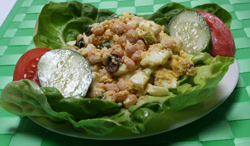
This healthful combination of eggs, white beans and olives has a deliciously Mediterranean flavor and tastes great on whole-wheat toast with romaine lettuce.

Egg Salad with White Beans - Makes 4 servings (2 1/2 cups egg salad mixture).
4 hard-cooked eggs
1 cup canned small white beans, rinsed and drained
3 Tbsp. chopped Kalamata olives
2 Tbsp. minced chives
1 tsp. Dijon-style mustard
3 dashes hot pepper sauce, or to taste
1/2 tsp. ground black pepper
8 Boston lettuce leaves
8 slices seedless cucumber, cut diagonally
1 large tomato, cut in 8 wedges
1 Tbsp. fresh lemon juice
1/4 tsp. salt
2 tsp. extra-virgin olive oil

In a mixing bowl, coarsely chop the eggs. Add the beans. Spread the olives on a paper towel and blot well, then add them to the salad. Add the chives, mustard, hot sauce and
1/2 teaspoon ground pepper. Using a fork, mix until salad is well combined.

Arrange 2 lettuce leaves on each of 4 salad plates. Mound one-fourth of the egg salad in the center of each plate.

Place the cucumber and tomatoes in a mixing bowl. In a small bowl, whisk the lemon juice with 1/4 teaspoon salt until the salt dissolves, then whisk in the oil. Add pepper to taste. Pour the dressing over the vegetables and toss to coat. Arrange 2 cucumber slices and 2 tomato wedges on each plate around the salad. Serve immediately.

Per serving: 167 calories, 7 g. total fat (2 g. saturated fat), 14 g. carbohydrate, 10 g. protein, 3 g. dietary fiber, 266 mg. sodium.

 
Author:

“Something Different” is written by Dana Jacobi, author of 12 Best Foods Cookbook and contributor to AICR’s New American Plate Cookbook: Recipes for a Healthy Weight and a Healthy Life.

The American Institute for Cancer Research (AICR) is the cancer charity that fosters research on the relationship of nutrition, physical activity and weight management to cancer risk, interprets the scientific literature and educates the public about the results. It has contributed more than $86 million for innovative research conducted at universities, hospitals and research centers across the country. AICR has published two landmark reports that interpret the accumulated research in the field, and is committed to a process of continuous review. AICR also provides a wide range of educational programs to help millions of Americans learn to make dietary changes for lower cancer risk. Its award-winning New American Plate program is presented in brochures, seminars and on its website, www.aicr.org. AICR is a member of the World Cancer Research Fund International.
Article Source: Aicr.org
Article Posted: August 17, 2003


Recommended For You...

Channel Guide
Beauty Center
Health Center
Home and Family
Crafts Center
Cooking Center
Cleaning Center
Gardening Center
Inspirational Quotes

Letters From You!
Dear PT,

...

Pioneer Thinking

Community

Video categories

Contact us

About Us

Advertising

Privacy

Terms Of Use

Article Submissions
 
Pioneerthinking.com Logo
Ingredients for a Simple Life
 
© Copyright 1999 - 2013 Pioneer Thinking. All Rights Reserved Worldwide
* tm; the property of Pioneer Thinking Company.